
Designing a Loyalty Ecosystem for Southeast Asia Motorcycle Riders
A leading Southeast Asian motorcycle company asked for a loyalty program. What they needed was a system connecting riders, dealers, and lifestyle partners into one economy inside their consumer app.
The Brief: Connect with the Rider’s Life
A motorcycle is purchased only once every 4–6 years, creating a long gap with little direct interaction between the brand and its customers. A traditional points program wouldn’t sustain engagement across that ownership cycle. Our challenge was to redefine the relationship beyond the transaction — to find where the brand could add meaningful value in riders’ everyday lives, and turn that into measurable growth for the consumer app.
Rather than starting with interface design, we began by understanding the existing service ecosystem: not only what riders experienced, but the operational, commercial, and organizational systems shaping those experiences. This gave us a grounded view of where the structural opportunities were.
The Problem, in Numbers
When the project began, the data told a clear story:
- Download growth was decelerating the curve was flattening around 450K total downloads.
- MAU had been flat at 102–106K for 3 months. Riders downloaded the app, registered, and then had no reason to return. Only ~28% of downloaders were still active in any given month.
Engagement was the weakest stage of the funnel. Every design decision that followed traces back to these two numbers.
The Process
Step 1: Understanding the Current-State System
We mapped the end-to-end customer experience across every touchpoint — from awareness and dealership interactions to ownership, servicing, and post-purchase engagement. Alongside customer journeys, we documented the operational systems, business processes, marketing activities, and success metrics supporting each stage, so the whole team shared one view of how the experience actually worked.
Step 2: Identify System Gaps and Opportunity Areas
With the ecosystem mapped, we analyzed where the experience consistently broke down: disconnected touchpoints, fragmented ownership experiences, and moments where customer expectations diverged from business capabilities.
2 gaps mattered most:
- Onboarding created friction before value. New riders had to work through registration steps before seeing what the app could do for them.
- Nothing brought riders back. After registration, there was no re-engagement loop, no reason to open the app between service visits.
These matched the funnel data exactly, and became the two priorities for design intervention.
Step 3: Define the Future-State Experience.
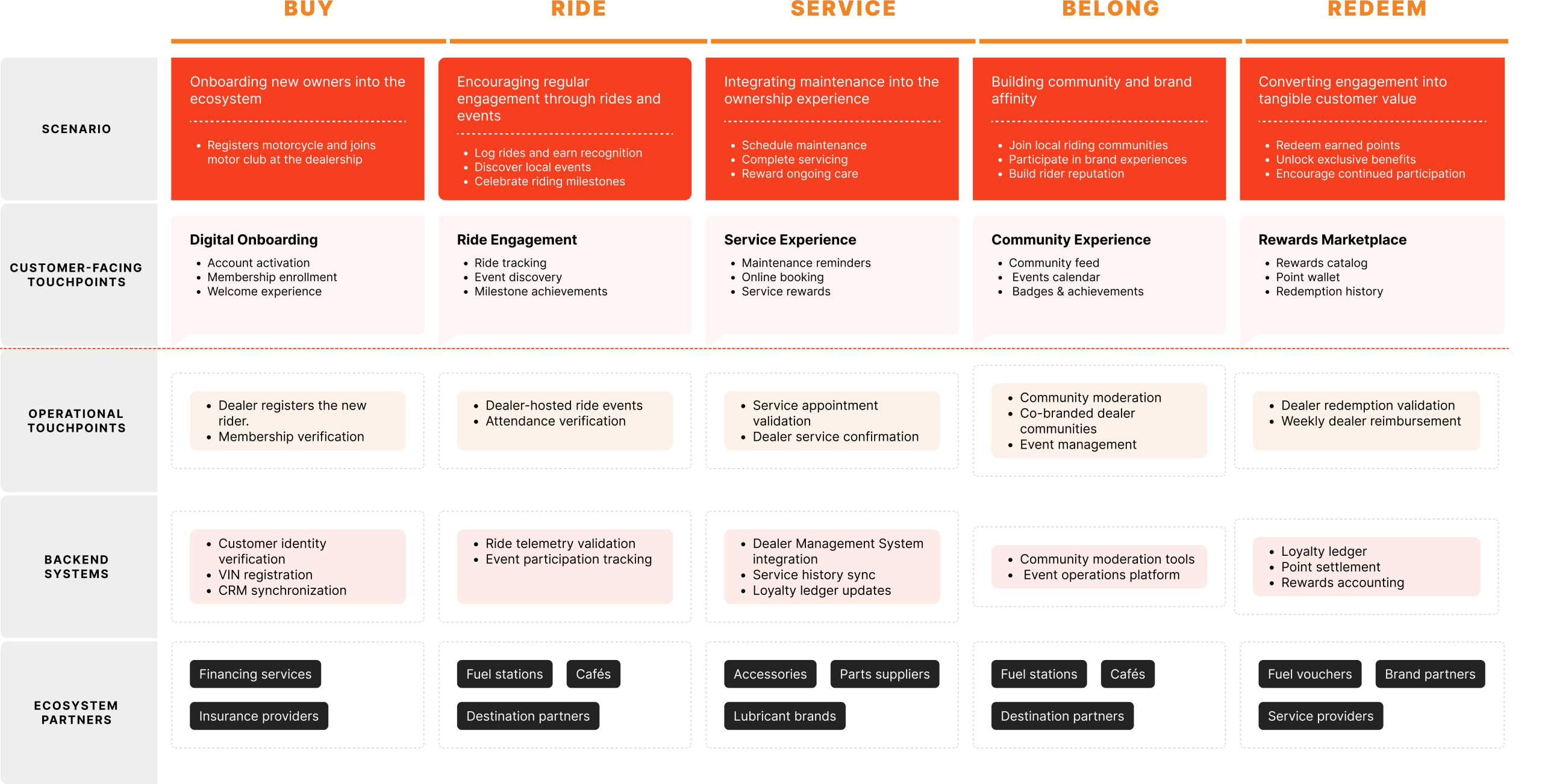
Working with the CX strategy team, marketing, and cross-functional stakeholders, we developed a service blueprint around 5 loops of the rider’s life: Buy, Ride, Service, Belong, Redeem. Each loop connected customer-facing touchpoints to operational touchpoints, backend systems, and ecosystem partners (dealers, fuel stations, cafés, insurers).
The blueprint became a shared decision-making framework. It exposed operational dependencies before development began and ensured every feature could be traced back to a customer need and a measurable business outcome, each loop carried its own success metrics, reviewed at steering-committee level.
The experience, once the system held
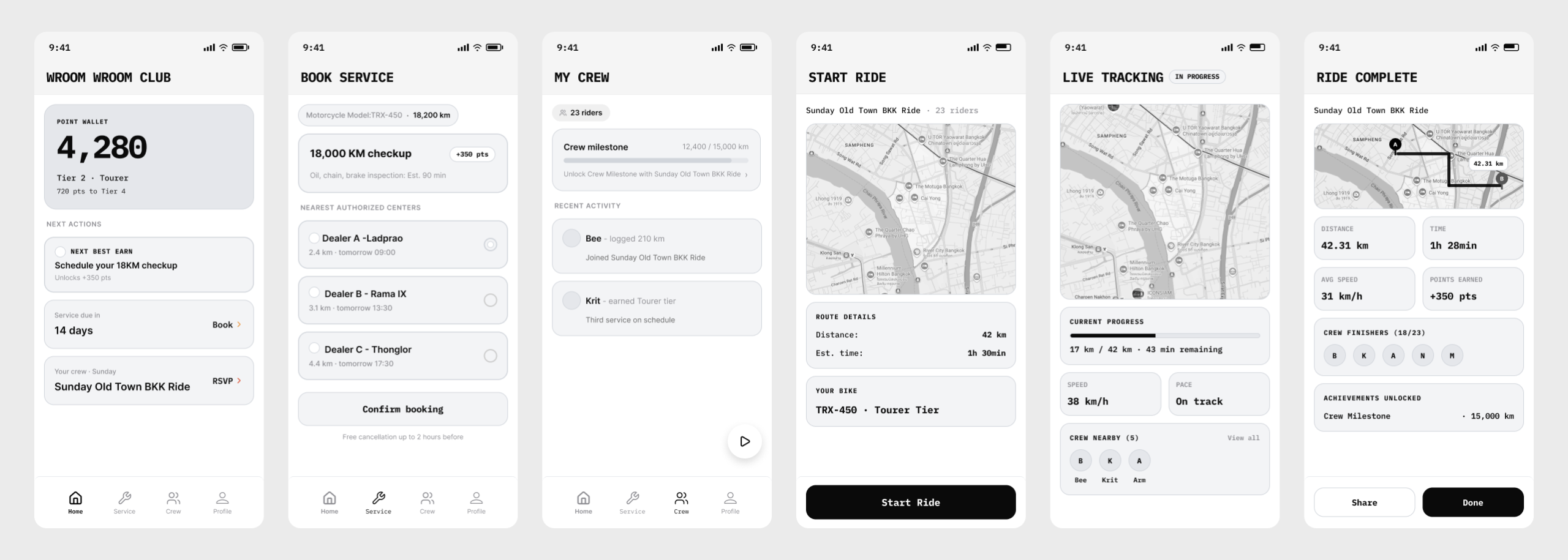
With the journey blueprint agreed, the interface followed quickly: 3 core surfaces, each expressing one loop of the system the club wallet and service booking (Buy / Service / Redeem), the crew and ride-tracking experience (Ride / Belong), and milestone-based achievements connecting all 5 state of customer journey.
With the blueprint agreed, I designed and shipped the two highest-leverage interventions:
1. Onboarding Journey Redesign
I redesigned digital onboarding around “value first”: riders see the ecosystem’s benefits and their membership status before completing the heavier verification steps, and dealers were woven in as an activation touchpoint rather than a bottleneck.
Result: the growth curve visibly inflected at launch. Over the following 4 months the app added ~220K downloads compared with ~90K in the two months prior while holding download-to-registration conversion at a steady 86%, even as the campaign drove large volumes of new traffic. The improved onboarding meant that traffic converted instead of leaking.
2. Push Notification Re-engagement Journey
To fix retention, I designed an engagement-driven notification journey built on nudging and habit-formation principles (Design for Behaviour Change certification, Thammasat Design Center): service reminders tied to odometer milestones, ride events, and community activity reasons to return that map to a rider’s real life, not generic promotions.
Result: Monthly Active Users (MAU) among registered users grew by 76% within 6 months.
What this project says about how I work
The interface came last, by design. The real product was the system: riders, dealers, operations, and partners connected in one economy. And the system proved itself in numbers: the growth curve inflected twice, exactly where the design shipped.
Next step: the download-to-MAU ratio is still the biggest opportunity. My hypothesis was to segment the re-engagement journey by rider type (commuter, touring, community-driven) and personalize the triggers and the next experiment in the queue.